Best Walking Pad for Carpet 2026: 5 Models That Handle Thick Carpet
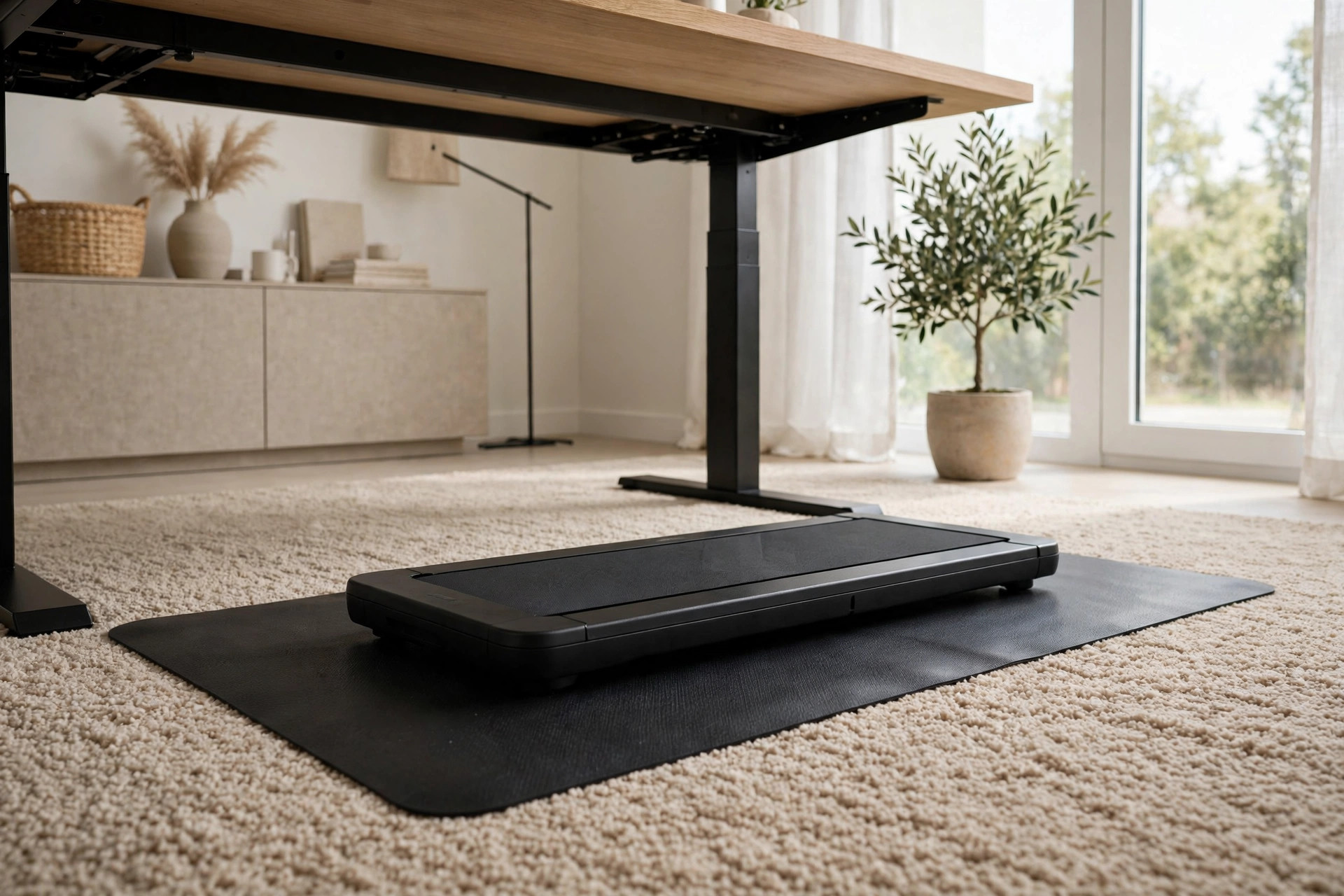
Most walking pad reviews assume a hard floor. In real homes, the machine often lands on carpet — and carpet changes the equation: thick pile swallows the machine’s feet, traps heat under the motor housing, and sheds fibers into the belt and vents.
The five models below were chosen for carpet-specific reasons: motors with genuine headroom, stable wide bases, and makers that do not hide from carpet questions. Every spec and price was checked against manufacturer pages and reputable retailers in October 2026. Where a figure could not be verified, we say so instead of printing it.
Quick picks
- Best overall on carpet: KingSmith WalkingPad R2 — 17″-wide belt, brushless motor, folding handrail. $599 (was $799).
- Best published motor: UREVO Strol 2S Pro — 2.5 HP continuous, 9% auto incline, 265-lb capacity. Price not verifiable — check the button.
- Best compact desk pick: Egofit Walker Pro M1 — maker endorses mat-on-carpet use; 48.5 lbs, 5% incline. $459.
- Best budget: THERUN 2.5HP — 265 lbs, 35.5″ belt. ~$179.99.
- Best wide belt with power: YOSUDA T200-S — 3.0 HP, 42″ × 17″ belt, safety key. Price not verifiable — check the button.
Comparison table
| Model | Carpet suitability | Motor | Speed range | Belt size | Price |
|---|---|---|---|---|---|
| KingSmith WalkingPad R2 | Excellent — brushless motor, wide feet, handrail | Brushless (continuous rating not published) | 0.5–7.5 mph | 47″ × 17″ | $599 (was $799) |
| UREVO Strol 2S Pro | Very good — 2.5 HP continuous, 8-point shock absorption | 2.5 HP continuous (per Target) | 0.6–7.6 mph | 42″ × 16″ | Not verifiable |
| Egofit Walker Pro M1 | Very good — maker supports mat-on-carpet use | 2.0 HP | 0.62–3.1 mph | 34.25″ × 16.54″ | $459 |
| THERUN walking pad | Good — 2.5 HP headroom; mat required on thick pile | 2.5 HP | 0.6–3.8 mph | 35.5″ × 15″ | ~$179.99 |
| YOSUDA T200-S | Good — 3.0 HP, 17″ belt; mat required on thick pile | 3.0 HP | 0.6–3.7 / 0.6–7.5 mph | 42″ × 17″ | Not verifiable |
Figures come from manufacturer pages and reputable retailers checked October 2026. “Not verifiable” means no reliable current US price source was found — use the buy button for the live number. Only the UREVO’s 2.5 HP is retailer-listed as continuous-duty.
What makes a walking pad carpet-friendly
1. Use a mat — non-negotiable, even on low pile
Every reputable source says the same thing: put an equipment mat between the pad and the floor, carpet included. A mat stops the machine’s feet from digging into the pile and — the part people forget — keeps carpet dust and fibers out of the motor and electronics, the number-one longevity killer on carpet (BarBend, Greatmats). A 68″ × 24″ PVC or rubber walking-pad mat costs about $25–$40 on Amazon.
2. Ventilation is the real motor killer
Motors breathe from underneath. On thick carpet, the housing can sink until the pile presses against the vents — choking airflow exactly while the soft surface makes the motor work harder. More load plus less cooling is how budget motors die early. This is why brushless motors (WalkingPad R2) and honestly-rated continuous motors (UREVO 2S Pro’s 2.5 HP continuous) matter: more thermal headroom. If the pad rocks when you step on, it needs a firmer surface (see the plywood trick below).
3. Thick pile vs. low pile: know your carpet
Low-pile commercial or berber-style carpet with a mat underneath is genuinely fine for any model here. Thick plush, frieze, or shag is a different animal: the pad wobbles, belt speed fluctuates, and the motor strains. A trainer quoted by BarBend puts it bluntly — avoid thick or shag carpet if you can. On shag, even a mat crinkles and slides: relocate the pad or use the plywood-and-mat stack.
4. The plywood trick for plush carpet
For plush carpet, fitness-equipment technicians recommend a 3/4-inch plywood board, cut to mat size, placed under the mat. Sandwich order: carpet, plywood, mat, pad. Under $30 at a hardware store, and it creates a level platform that keeps the motor housing clear of the fibers. Check the pad’s leveling feet after placement.
5. What to look for in the machine itself
Prefer a continuous-duty or brushless motor over a peak-rated one — carpet adds rolling resistance, so a motor near its limit on a hard floor is past it on carpet. A wider stance and a handrail option add stability on compressing surfaces. Transport wheels let you move the pad off the carpet between sessions, sparing the carpet permanent dents. And noise matters more in apartments: soft floors transmit the pad’s thump to the unit below.
Full reviews
KingSmith WalkingPad R2
The R2 is the best-documented carpet pick here. The brushless motor runs cooler and quieter than the brushed motors in most budget pads — the exact quality you want when carpet is stealing cooling airflow. The 47 × 17-inch belt is generous for the category, the folding handrail steadies you on a springy surface, and FootSense auto-speed smooths the speed wobbles of soft flooring.
Two honest caveats. KingSmith publishes no continuous HP rating, so its motor output cannot be compared against the UREVO’s 2.5 HP continuous on paper — only the cooler, quieter real-world behavior argues for it. The $599 sale price (was $799) is verified on walkingpad.com as of October 2026.
- Brushless motor — cooler and quieter, the key carpet trait
- 47″ × 17″ belt; roomiest here
- Folding handrail; safety clip + child lock
- Continuous HP rating not published
- $599 is premium pricing here
The safest carpet pick. The motor design and safety documentation justify the premium.
Prices change frequently — the button checks the live price.
UREVO Strol 2S Pro
The 2S Pro is the only model here with a published continuous-duty motor rating — from Target’s product specs, not manufacturer marketing. On carpet, continuous HP is the number that matters: sustained load before heat becomes the limit. Add 8-point shock absorption and a 74.5-lb frame, and this is the carpet workhorse of the roundup.
The trade-offs: at 74.5 lbs, moving it between rooms is a commitment — though transport wheels help. We could not verify a current US list price, so treat the button as the price check. The 265-lb capacity and 42 × 16-inch belt come from Target and Amazon US listings.
- 2.5 HP continuous — the only published continuous rating here
- 265-lb capacity; 9% auto incline
- 74.5-lb frame; 8-point shock absorption
- Current US price not verifiable
- 74.5 lbs — heavy to move between rooms
The honest motor pick — a published continuous rating, not marketing adjectives.
Prices change frequently — the button checks the live price.
Egofit Walker Pro M1
The Egofit is the only model here whose own Amazon copy talks about carpet directly: the manufacturer says a mat over carpet dampens sound further — an explicit endorsement of the setup we recommend. At 48.5 lbs it is the lightest full-featured model here: onto the mat for a session, against the wall after, and the carpet recovers instead of denting.
The compact footprint comes with compact numbers: a 220-lb capacity, a 34.25-inch belt tall users will find short, and a 2.0 HP motor with the least headroom here. The fixed 5% incline is a genuine plus at desk-walking speeds, and Garage Gym Reviews confirms it works well on carpet. $459 verified via an Amazon listing aggregator in October 2026.
- Manufacturer endorses mat-on-carpet use
- 48.5 lbs — move it off the mat between sessions
- Fixed 5% incline boosts walking intensity
- 220-lb capacity — lowest here
- 34.25″ belt is short for taller users
The desk-walker’s carpet pick: small, light, maker-approved on carpet.
Prices change frequently — the button checks the live price.
THERUN Walking Pad (2.5HP)
The THERUN is the cheapest way in with a 2.5 HP motor and 265-lb capacity — on paper matching machines costing twice as much. On low-pile carpet with a mat, that is legitimate value, and the 4.96-inch deck slides under a couch after the session so the carpet recovers.
Keep expectations honest: the 2.5 HP is not labeled continuous, the 15-inch belt is the narrowest here, and there is no safety clip — just the remote stop. On thick plush, give it the mat-and-plywood stack rather than carpet alone. ~$179.99 from a Dealmoon listing refreshed October 2026 (Amazon showed $99.99 in an older crawl); verify live.
- 2.5 HP and 265-lb capacity at the lowest price here
- 4.96″ deck stores under a couch
- HP not labeled continuous
- 15″ belt — narrowest here
- No safety clip or child lock listed
The budget entry for carpet: fine on low pile with a mat, needs plywood on plush.
Prices change frequently — the button checks the live price.
YOSUDA T200-S Walking Pad
The YOSUDA pairs the strongest claimed motor here (3.0 HP) with a 42 × 17-inch belt — full-walk width on a frame that folds under 5 inches. On carpet that combination is attractive: the most claimed motor headroom and a wide belt that keeps your stride centered on a soft surface. A safety key is included — the physical stop the cheapest pads skip.
Two caveats, plainly. The 3.0 HP figure is a maximum rating, not continuous — a marketing ceiling, not measured output. We could not verify a current US price: listings confirmed the specs (3.0 HP, 265 lbs, 42 × 17-inch belt, 0.6–7.5 mph) but not a dollar figure, so use the button.
- 3.0 HP claimed — strongest on-paper motor here
- 42″ × 17″ belt; safety key included
- 3.0 HP is a max rating, not continuous
- Current US price not verifiable
The strongest on-paper motor and a genuinely wide belt. Verify the live price first.
Prices change frequently — the button checks the live price.
Frequently asked questions
Can you put a walking pad on carpet?
Yes, with a mat between the pad and the carpet — always. The mat protects the carpet from crushed pile and blocks fibers from entering the motor and electronics. Low-pile carpet with a mat is fine for any model in this guide. Thick plush, frieze, or shag is harder: expect wobble and motor strain, and consider the plywood-and-mat stack described above.
Do I need a mat under a walking pad on carpet?
Yes. Equipment-mat makers and reviewers are unanimous: a mat on carpet stops the machine’s feet from digging in and damaging the pile, keeps the pad from shifting, and blocks carpet dust from entering the motor housing.
Will carpet damage the walking pad’s motor?
It can shorten the motor’s life if the setup fights it. Carpet adds rolling resistance while thick pile can press against the underside vents and choke cooling. The two defenses are a motor with real headroom (brushless, or a published continuous rating like the UREVO’s 2.5 HP) and a firm setup — mat on low pile, mat plus plywood board on plush. A pad that rocks when you step on is telling you the motor is working too hard.
What about thick, plush, or shag carpet?
That is the one carpet type we would steer you away from — or toward the full workaround. A trainer quoted by BarBend recommends avoiding thick or shag carpet for treadmill-style equipment outright. If the pad must go on plush, use the 3/4-inch plywood board under the mat for a level platform, and favor the strongest-motor models here (WalkingPad R2, UREVO 2S Pro, YOSUDA T200-S).
Why is Sperax excluded from this guide?
In April 2026 the CPSC issued Warning #26-415 against Sperax walking pads and treadmills (Pro, Q1, RM-01, RM-02): stop using them immediately and dispose of them. The warning cites 201 speed and stability reports causing 66+ falls and injuries (including one concussion) and 573 overheating and fire reports causing 4 minor burns. The importer refused a recall, so there is no refund or repair program. We checked the other five brands against CPSC records in October 2026 and found no recall or stop-use actions for them.
Prices move. We check regularly but the checkout number may differ.